Georgia records 5.5 million tourist visits as Kobakhidze government faces two-year protest milestone
The country’s economy expanded 7.5% last year even as demonstrators mark the anniversary of the elections that triggered a sustained political crisis.
By Isaac Thompson ·
Monday marks two years since the contested parliamentary elections on 26 October 2024 that ignited the current political crisis in Georgia. The protests began two days after the vote and reached their peak on 28 November, when the government announced it would not put the opening of EU negotiations on its agenda before the end of 2028.
Despite this standoff, the country recorded a high of more than 5.5 million international tourist visits in 2025. Data from the Georgian National Tourism Administration shows this figure represents an 8.4% increase on 2024. It is also almost ten times the number of visitors who came to the country twenty years ago, a figure estimated at 560,000.
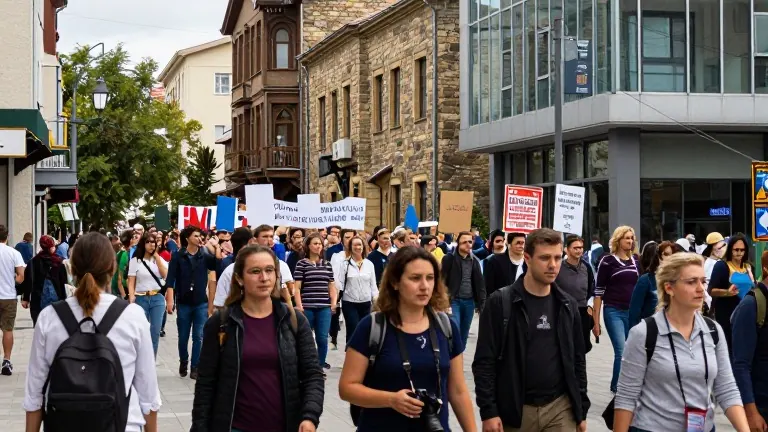
The surge in tourism coexists with one of the longest protest movements in recent history. Every weekend, crowds gather in Avlabari Square in Tbilisi’s Armenian quarter for the “Saturday March.” Demonstrators head towards the Bridge of Love, reach Freedom Square and march towards parliament. They chant slogans against the government of Irakli Kobakhidze and the Georgian Dream party, which has held power since 2012.
Critics accuse Georgian Dream of growing authoritarianism. They argue that the party’s decision to suspend EU accession talks is moving the country closer to Moscow. Georgia was granted EU candidate status in 2023, a step many citizens view as essential for closer ties to Europe.
The influx of visitors includes large numbers from the Middle East and Russia. After the full-scale invasion of Ukraine in 2022, tens of thousands of Russian citizens relocated to Georgia. These residents brought money and opened businesses, but they also exerted strong pressure on the property market by buying homes across the country.
This Russian presence has fueled discontent among a population that continues to consider Russia an occupying power. Locals remain mindful of the early 1990s wars against Russian-backed separatists in South Ossetia and Abkhazia, as well as the brief August 2008 war fought against Moscow in South Ossetia.
Georgia is a republic roughly the size of Ireland with a population of fewer than 4 million. It emerged from the fall of the Soviet Union in 1991. The country offers attractions that draw tourists, including mountain villages along the Georgian Military Road, ancient Orthodox churches, and the port of Batumi on the Black Sea. Tbilisi, with its repurposed industrial spaces, is often compared to 1990s Berlin.
The nation’s economy remains tied to Moscow despite severed diplomatic relations. Trade, tourism, remittances, Russian capital, and energy imports prop up the economy. GDP rose by 7.5% in 2025, marking five consecutive years of expansion. However, the country continues to be affected by unemployment, low wages, widespread poverty, and depopulation in many rural areas.
Relations with Brussels have deteriorated recently. The EU has criticized the Georgian government’s record on the rule of law and political repression. Many believe a strengthening of Moscow in the Ukraine war could increase its ability to exert pressure on the Caucasus.
The political landscape in Georgia is defined by a contradiction that is difficult to resolve. After the 2008 conflict, Russia consolidated military control over Abkhazia and South Ossetia, regions accounting for approximately 20% of Georgian territory. This has left the country internationally isolated and with limited domestic support for the current direction of governance.
Source: The Guardian